The Painting That Mirrored the Future
Will a Thrift-Store Find Become a $7.89 Million Masterwork?
My business takes me in and out of art galleries. I work in the field of provenance and take great joy in searching out paintings that need to be reunited with their histories.
Acquiring Blue Ribbon Unfurled was one of those moments when you feel like you have acquired a Picasso in his prime for $439.77. Margaretta was a mid-century female painter. The $7.89 million is not an arbitrary figure because Helen Frankenthaler, another mid-century female painter, recently achieved that price at auction. These women painters are being reevaluated because they were often not valued as they should have been in their lifetimes.
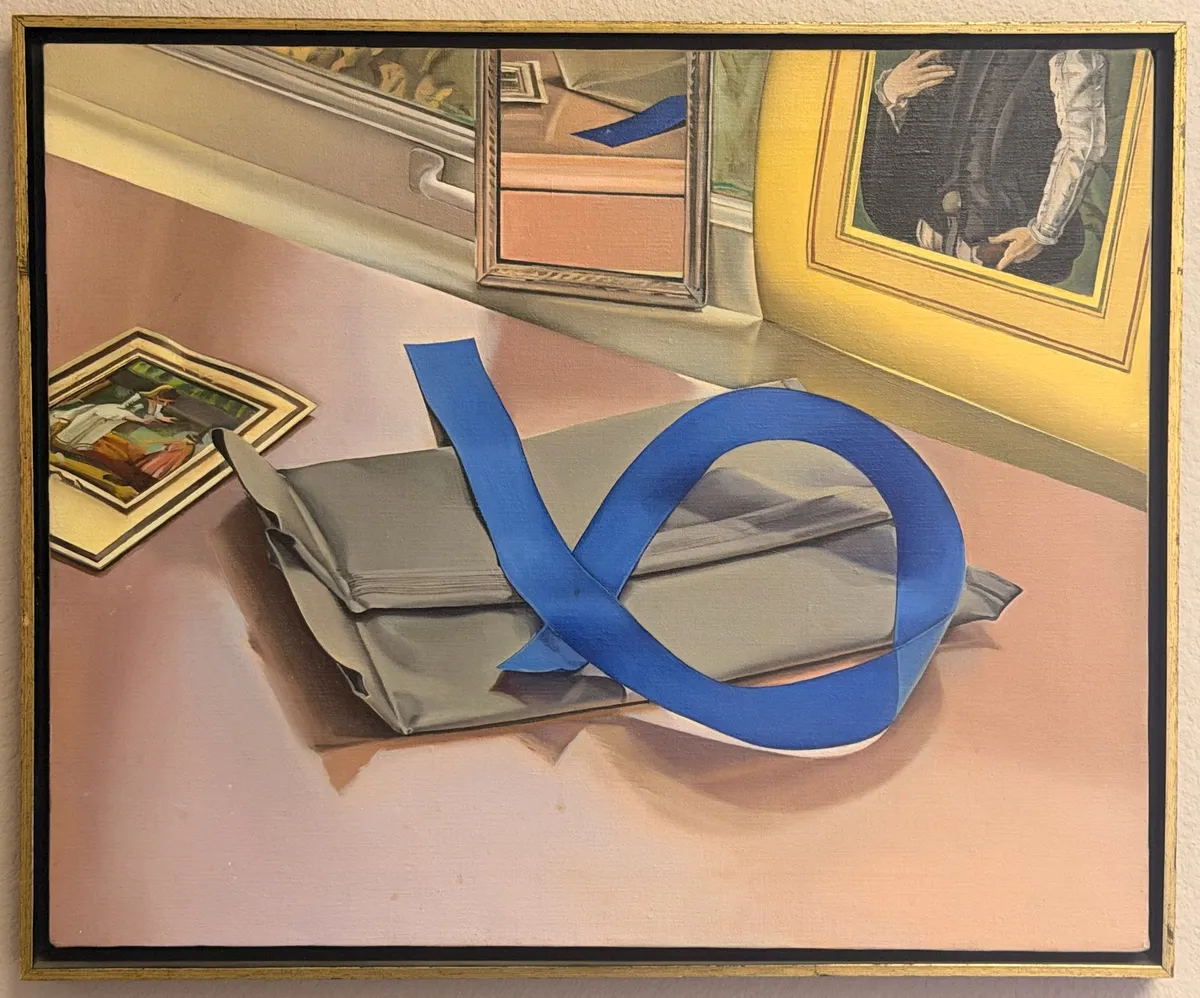
Imagine a painter who controls a visual and narrative framework so powerfully on canvas that its artistic reality manifests externally. Margaretta Gilboy is such a painter. She is no longer alive, but her painting, Blue Ribbon Unfurled, is still willing her into the pantheon of painters who matter. The future seems to have leaked out of its oil paints.
I’m not one to shed tears over the whims of politics. But I do shed a tear when I see a painter like Gilboy and wonder at all the works we could have enjoyed had she been financially rewarded in her lifetime like Picasso, Warhol, or Johns. Genius female artists like Gilboy still had to teach and get credentialed rather than be set loose to solely pursue their artistic visions.
Margaretta Gilboy was not unrecognized in her lifetime. In March 1979, American Artist, one of the country’s leading magazines devoted to professional painters, featured a Gilboy on its cover for an article titled “Realism Plus: Margaretta Gilboy,” written by Eve Medoff. Blue Ribbon Unfurled was one of seven paintings featured in the article.
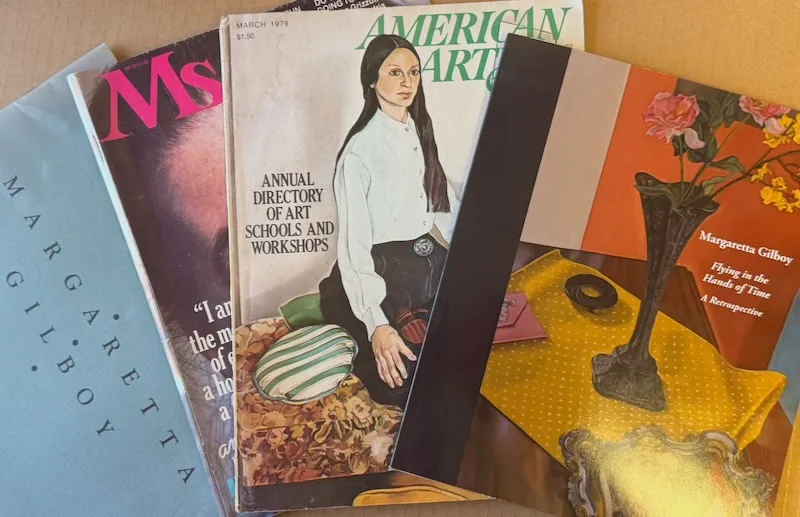
She also had pop culture appeal, being discussed and having her painting shown to the 500,000 readers of Ms. magazine in May 1977.
Gilboy exhibited professionally, attracted critical attention, and developed a substantial body of work over decades. Her paintings were discussed in newspapers and art publications, including The Philadelphia Inquirer, The New Art Examiner, and the Rocky Mountain News. Her work is represented in major institutional collections, including the Philadelphia Museum of Art, the Denver Art Museum, and the Boulder Museum of Contemporary Art.
Blue Ribbon Unfurled is registered in the CryptoNumbered provenance registry under CRI 00A-181-2880, with linked records documenting supporting historical materials. CRIs are ordinarily private, but this painting is owned by CryptoNumbered's founder, who has chosen to make its registration publicly accessible.
She was also invited to exhibit at the Naropa Institute, where she may have crossed paths with William S. Burroughs. While one worked in oil and the other in ink, both were deeply fascinated by the ‘transitory nature of existence’ and the unsettling possibility that art doesn't just reflect life, but can ‘pre-record the future’.
How good was she?
Imagine the hardest object you can think of painting and making it incredibly alive and vibrant. Margaretta Gilboy chose a ‘gray envelope’ as the central focus point of Blue Ribbon Unfurled (and blue ribbon).
This was no lightweight study. Gilboy deftly transformed a gray envelope and blue ribbon into a vibrant, dynamic composition. She then confidently submitted the painting for a major exhibition at the Denver Art Museum, where it was celebrated. Its success led to its acquisition for the Amoco Oil Company art collection by curator, Simon Zalkind.
Gilboy could do anything with paint and had complete control of the canvas. You can see this in the nearly photorealistic gray envelope with its waves and cast shadows. The envelope has unmistakable energy and architectural qualities, and we want to know what was, or is inside.
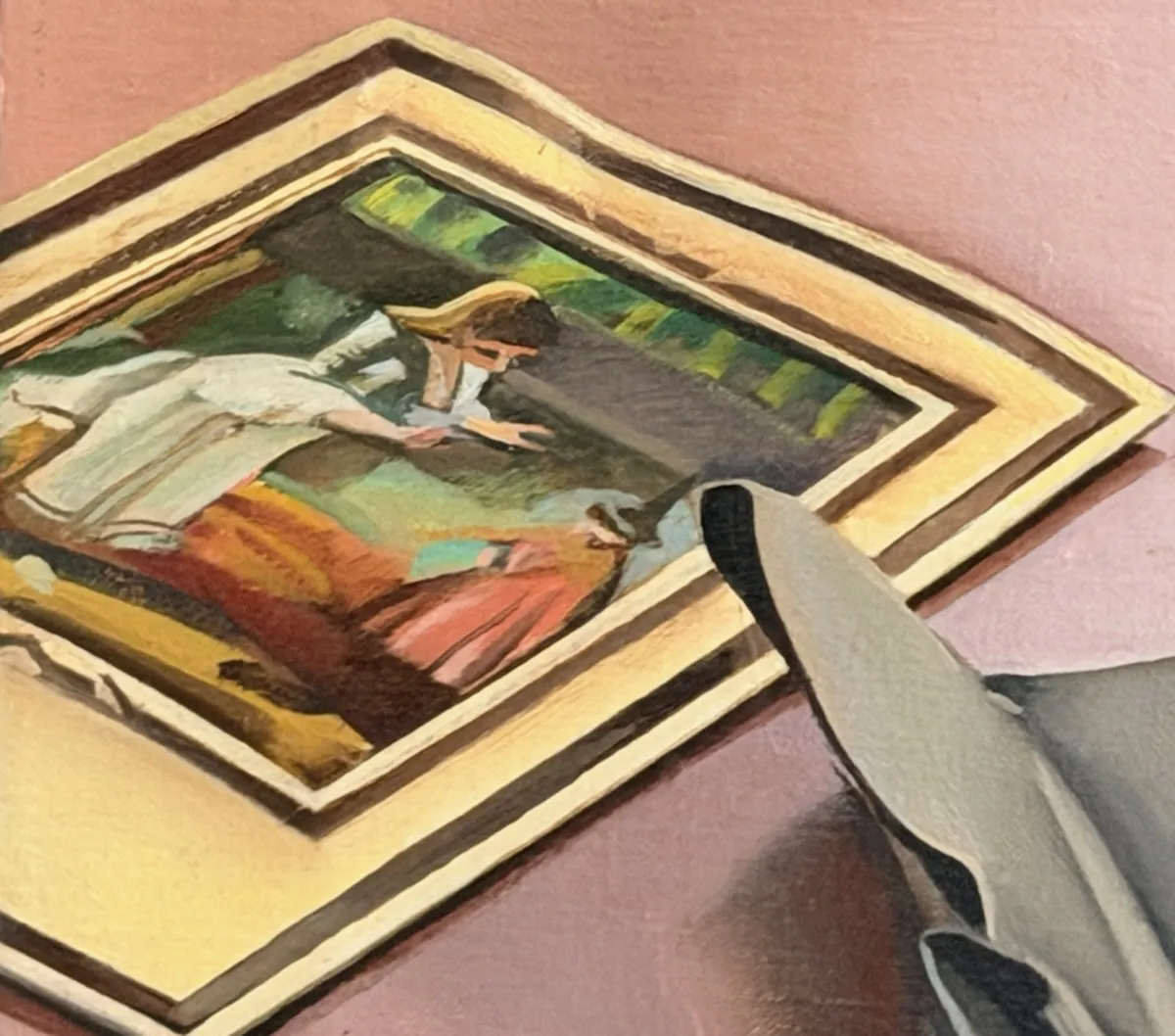
Margaretta (or Maggie) loved creating still-lifes you immediately understand, but that become increasingly uncomfortable the longer you look, as though she has fractured space itself. In Blue Ribbon Unfurled, you seem to be looking at a countertop with images and a mirror, but things don’t quite add up. After studying it for a long time a realization hits: the whole painting is a mirror reflection, and the perspective straightens out when viewing the painting from an oblique angle, as though approaching a mirror hanging on a hallway wall.
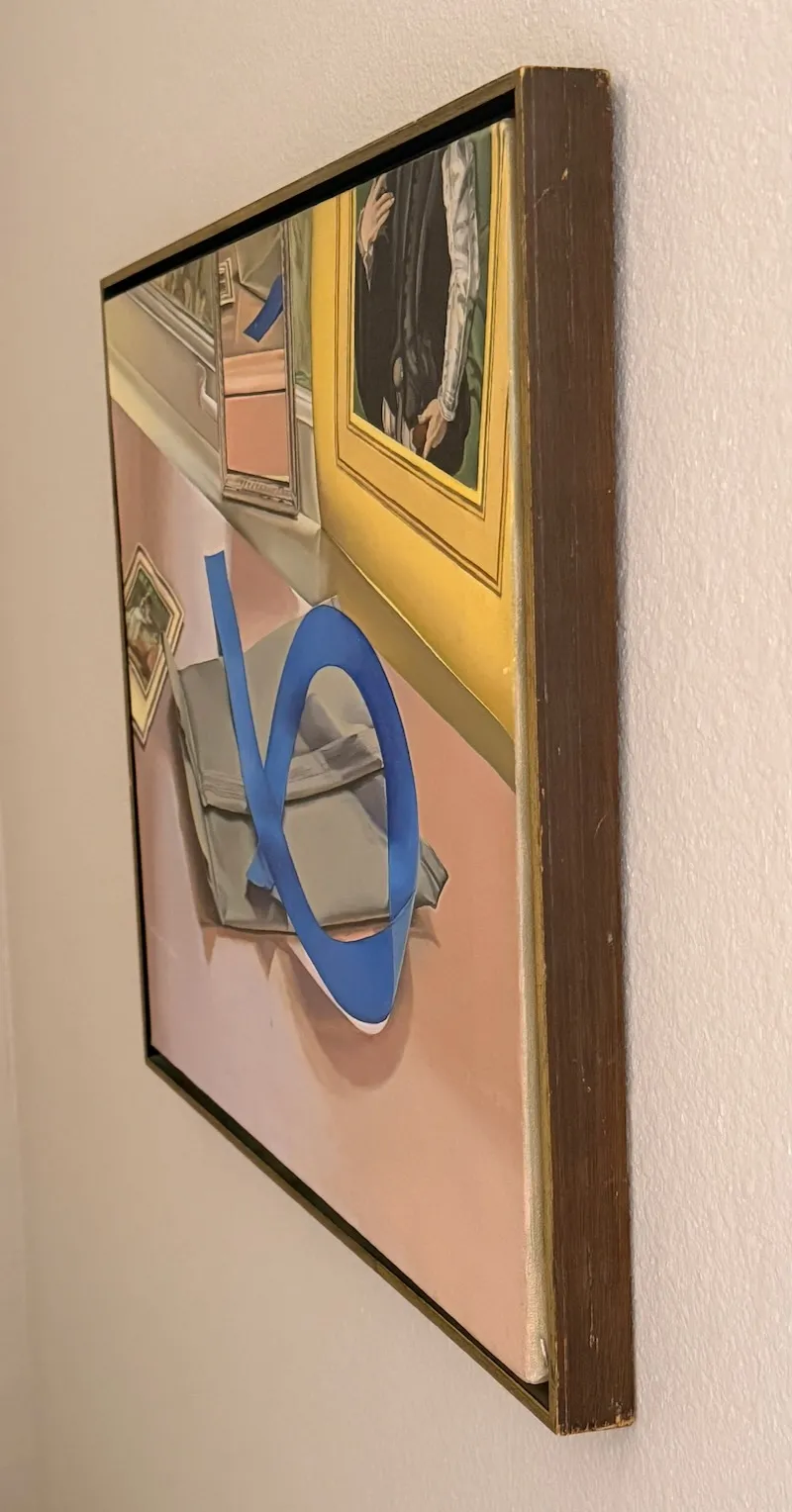
The colors are soothing, which is something of a favor to the viewer, because the arrangement of objects is unsettling and demands constant reconsideration. These reflections are extraordinarily difficult to construct, both mathematically and artistically.
But the reflections aren’t merely about light and mirrors.
The painting is a devastating critique of the art world, in addition to being a masterpiece of reflection, color, storytelling, and playfulness.
Gilboy is painting a representation of her benefactors, the corporations and art institutions that confer prestige, represented by the institutional gray envelope and the blue ribbon. She mirrors these modern patrons against one from 400 years earlier through a cropped reproduction of Bronzino’s Portrait of Lodovico Capponi, a Renaissance masterpiece.
Capponi belonged to a wealthy Florentine family closely connected to the Medici, among the Renaissance’s greatest patrons of art. The choices are dripping with irony. Four centuries ago, wealthy patrons were flamboyant and wanted to be painted themselves, ‘to become part of the art.’
Gilboy gives their modern counterparts the same privilege, lovingly representing them as a gray institutional envelope occupying a central position in her painting. Meanwhile, the actual art: a delicate, fairy-like woman on the left, her hands raised as if casting a spell, is casually cast to the margins. It is as though the magic of the painting is being actively ignored in favor of the corporate stationery that funded it.
I’ve already given away that I purchased Blue Ribbon Unfurled inexpensively at a thrift-store auction. In fairness to the other bidders, most rely on auction histories to establish value, and Gilboy has very little auction history. Much of her work remains in private and institutional collections or with her estate.
Bronzino’s Portrait of Lodovico Capponi had its own provenance mystery. For centuries, the identity of the young man in the portrait was lost. It was eventually recovered through a corresponding facial image of the portrait incorporated into a fresco in the Capponi family’s Florentine palazzo. In effect, a painting regained part of its history because its image had survived inside another work of art.
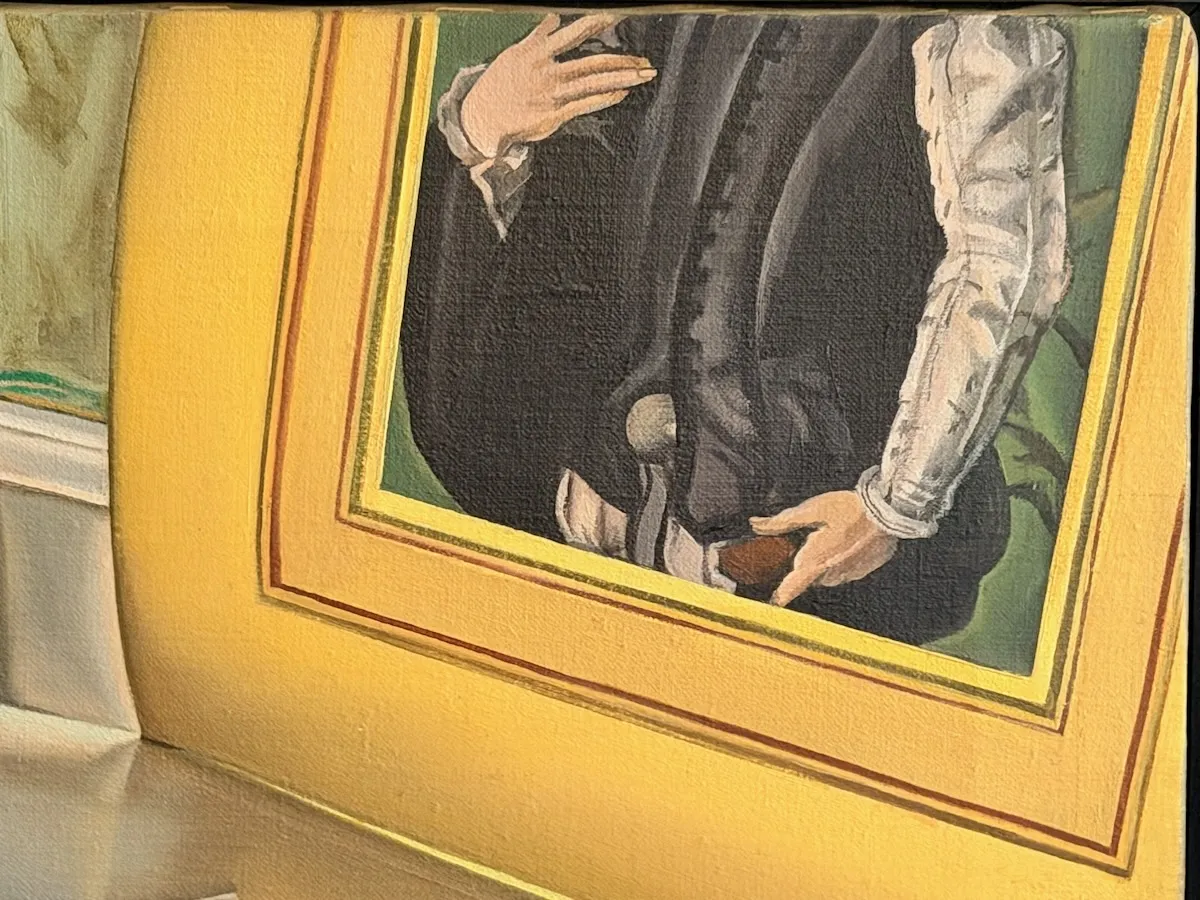 And nearly four centuries later, Gilboy placed a cropped version of that very portrait inside Blue Ribbon Unfurled, a painting whose own history would eventually need to be recovered.
My take is that Gilboy was very effectively critiquing the art world and how institutions, from major art museums to corporate collectors like Amoco Oil Company, had become so powerful and opaque in bestowing privilege that the images themselves were secondary. With all the reflections in Blue Ribbon Unfurled, we still never see anything inside the gray envelope.
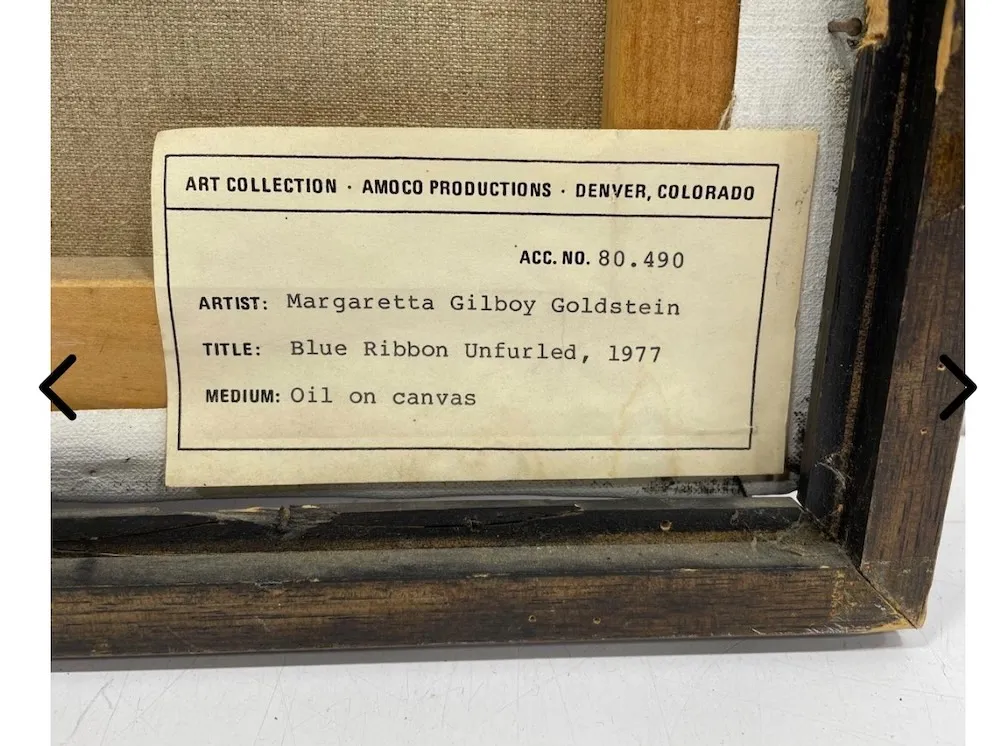
In 1998, British Petroleum merged with Amoco, and the corporate art collection eventually appears to have been deaccessioned. We don’t know what happened to Blue Ribbon Unfurled for much of the next three decades, but we can say it’s magic was cast aside, until it was my great fortune to find it at a thrift-store auction with its original Amoco collection label still on the back.
There is a strange synchronicity to how Gilboy controlled her canvas. Decades after she painted Blue Ribbon Unfurled, fellow Naropa figure William S. Burroughs wrote about the terrifying 'trick' of authorship - the rare, eerie phenomenon where an artist writes or paints a deep, complex reality, only for the physical universe to later manifest those exact events.
“Anybody can write ‘And then he shot himself’ and then shoot himself, if he is prepared to do this. I’m talking about someone who writes ‘And then he was shot’ and is himself shot by someone else. That’s the trick.”
Gilboy pulled off this exact trick. By taking the modern corporate patron, transforming them into a central gray institutional envelope with a blue ribbon, and depicting an artwork then casually cast to the margins, she didn't just critique the art world of her present - she drew the blueprint for her painting's own institutional celebration, corporate purchase, abandonment and eventual rediscovery decades later. She painted a future that the real world was forced to live out.
Will the painting eventually fetch $7.89 million at auction like Helen Frankenthaler’s? That’s unknown, but a Margaretta Gilboy is a cultural treasure and my fortunate find.
David Henson is a provenance hunter and the founder of CryptoNumbered.com, a human-witnessed provenance network.